

Tree Pruning in the UK: The Complete Guide
Type tree pruning UK into Google and you’ll get a wall of advice that mostly contradicts itself. Prune in winter. No, prune in summer. Never touch a tree without a professional. Actually, anyone can do it with the right saw. It’s no wonder people put the job off for years, then end up paying more to fix a tree that should have been pruned a long time ago.
This guide sorts it out. We’re Treesaw, tree surgeons based in Yeadon covering Leeds, Bradford, Harrogate and Wakefield, and pruning is the bulk of what we do day in, day out. We hold Arboricultural Association Approved Contractor status, which fewer than a handful of firms across Yorkshire can say. What follows is the stuff we explain to customers on driveways every week. When to prune, what each cut actually does, what the law says, and what it should cost.
One thing before we start. Pruning done at the wrong time, or done badly, is worse than not pruning at all. A bad cut is a wound the tree has to live with for decades. So if you take nothing else from this guide, take the timing.
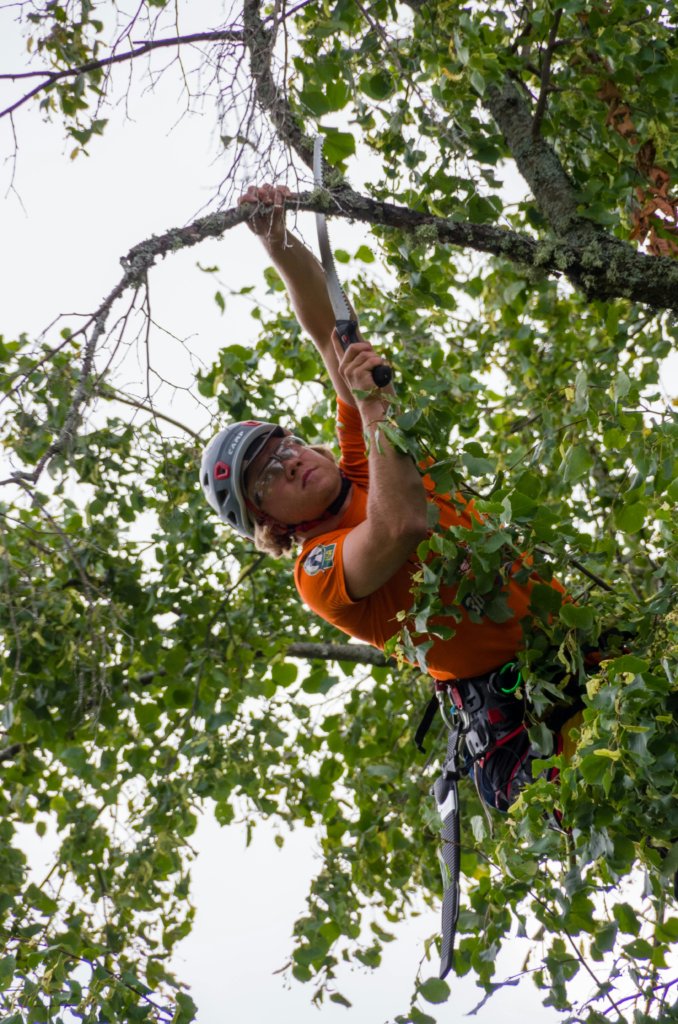
Why Prune a Tree at all
Trees managed themselves for millions of years before we turned up with saws. So why interfere?
Because garden trees and street trees don’t live in forests. A tree in a wood grows tall and narrow, sheds its own lower branches, and if it drops a limb, nothing happens. A tree in a garden in Horsforth grows wide, hangs over the shed, shades out half the lawn and drops that same limb on a fence, a car, or worse.
Pruning does four jobs. It removes dead and dangerous wood before gravity does it for you. It controls size, so the tree fits the space it’s in. It lets light and air through the canopy, which keeps the tree healthier and your garden brighter. And it shapes young trees early so they don’t develop problems later. That last one, formative pruning, is the cheapest tree work you’ll ever pay for and the most ignored.
There’s a rule of thumb our surveyors use: the three Ds. Dead, diseased, damaged. Wood in any of those categories can come off more or less any time of year. Everything beyond that is about timing.
When to Prune Trees in the UK
Here’s the general rule, and then the exceptions, because the exceptions matter more than the rule.
Most deciduous trees in the UK are best pruned in the dormant season, roughly November to early March. The tree isn’t actively growing, there are no leaves in the way so the structure is easy to read, and pests and fungal spores are largely inactive. For oaks, beeches, hornbeams and most native broadleaves, winter is the safe window.
But the exceptions:
Stone fruit prunes in summer. Cherries, plums and other Prunus species should never be pruned in winter. Silver leaf disease enters through fresh cuts and the spores are most active in the cold, damp months. Prune these from June to August when the tree can seal the wound quickly. We cover the detail in our guides to pruning plum trees and pruning cherry trees.
Bleeders prune in mid-summer or full dormancy. Maples, birches and walnuts pump sap hard in late winter and early spring. Cut them in February and they’ll bleed from the wound for weeks. It looks alarming, and while it rarely kills the tree, it weakens it and invites infection. Our acer pruning guide goes into this properly.
Magnolias hate winter cuts. They heal slowly and resent heavy pruning at any time. Light work in summer, after flowering. More in our magnolia guide.
Mediterranean species wait for warmth. Olives, figs and bays need rising temperatures to seal cuts. Prune in late spring once frost risk has passed. Our guide to pruning olive trees in the UK is a popular blog, which tells you how many people now have an olive in a pot in a British garden. The fig guide covers its cousin.
Conifers barely tolerate pruning at all. Most won’t regrow from old wood. Cut a leylandii back past the green and it stays brown forever. Timing and restraint both matter, and we’ve written about pruning leylandii and conifers separately because it’s where we see the most expensive mistakes.
Willows are their own thing. Fast growing, water hungry and brittle. See our willow pruning guide.
And one Yorkshire note, because national advice doesn’t always fit here. Spring arrives later on our side of the Pennines than it does in Surrey. A late frost in a Harrogate garden in May is not unusual. If you’re working off a generic UK calendar for frost-sensitive species, push your dates back two or three weeks. We’ve seen olives and figs caught out by following advice written for the south coast.

Tree Pruning UK Timing by Species, at a Glance
A quick reference. Bookmark it, because the question “when to prune trees UK wide” doesn’t have one answer, it has about ten.
Oak, beech, hornbeam, lime: November to early March. Apple and pear: winter for structure, summer for restricting growth, and our apple pruning guide explains the difference. Cherry, plum, blackthorn and all Prunus: June to August only. Maple, birch, walnut: mid-summer or deep winter, never late winter. Magnolia: summer, lightly. Olive, fig, bay: late spring after frost. Conifers and leylandii: spring to early summer, never into old wood. Willow and poplar: late winter, they shrug it off.
If your tree isn’t on that list, or you’re not sure what it is, send us a photo through our contact page. Identifying the species is the first thing our surveyors do on any visit, because everything else follows from it.
The Cuts Explained, in Plain English
Tree surgery has its own vocabulary and most of it sounds interchangeable. It isn’t. When you get a quote, these are the terms that will be on it, and it’s worth knowing what you’re agreeing to.
Crown reduction makes the whole canopy smaller while keeping its shape. Done properly it’s cut by cut, back to suitable growth points. Done badly it’s called topping, and topping is to pruning what a chainsaw is to a scalpel. More on that below.
Crown thinning removes selected branches through the canopy to let light and wind through, without changing the overall size or outline. If your problem is a dark lawn rather than an oversized tree, thinning is usually the answer. We’ve compared the two in detail in crown reduction vs crown thinning.
Crown lifting removes the lowest branches to raise the canopy. Useful over driveways, pavements and lawns you’d like to mow without ducking.
Pollarding is the hard one. The tree is cut back to a framework of main stems and then maintained that way on a cycle, every few years, forever. It’s a commitment, not a one-off. Street trees are often pollarded. It suits willows, limes and planes. It does not suit a 100 year old oak, whatever a bloke with a van and no qualifications tells you.
Deadwooding is the removal of dead branches, and formative pruning is light shaping of young trees. Both are routine for us and cheap relative to what they prevent.
A note on cuts themselves, because this is where DIY pruning usually goes wrong. Every cut should land just outside the branch collar, the slightly swollen ring where a branch meets the trunk. Cut flush to the trunk and you remove the tissue the tree uses to seal the wound. Leave a long stub and it dies back and rots inward. And forget wound paint. The industry stopped using it decades ago because sealing a wound traps moisture and decay inside. The tree compartmentalises the damage itself. It’s better at it than we are.
Tree Pruning UK Law: What You Can and Can’t Cut
This is the section people skip, and it’s the section that can cost you the most. Tree pruning UK rules sit in three areas, and ignorance is not a defence for any of them.
Tree Preservation Orders. If your tree has a TPO on it, you need written consent from the council before any work, including light pruning. Working on a protected tree without consent is a criminal offence with fines that can reach £20,000 per tree, and unlimited in serious cases at Crown Court. You can’t tell a tree has a TPO by looking at it. You check with the local authority, or you ask us, because we run that check on every single job before a saw comes out. It’s part of the process, not an extra. If consent is needed, we submit the application on your behalf, which typically takes six to eight weeks through the council.
Conservation areas. Live in one, and you must give the council six weeks written notice before working on any tree with a trunk wider than 7.5cm. Plenty of homeowners in places like Ilkley, Roundhay and central Harrogate are in conservation areas without realising.
Nesting birds. All wild birds, their nests and their eggs are protected under the Wildlife and Countryside Act 1981. There’s no fixed legal cut-off date, but nesting season runs roughly February to August, and cutting a tree or hedge with an active nest in it is an offence whatever the calendar says. We check before we cut, and sometimes that means telling a customer the job waits a month. They’re rarely thrilled. The fine would thrill them less.
There’s a wider piece on all of this in our guide to trees and the law, including what happens with overhanging branches and who’s liable when a tree falls. Worth a read if you share a boundary with anyone.
What Does Tree Pruning Cost in the UK?
Honest answer: it depends, and anyone who quotes you a price over the phone without seeing the tree is guessing.
But you deserve ballpark figures, so here they are. Light pruning on a small garden tree might run £150 to £300. Crown work on a medium tree, something like a 10 metre birch or rowan, typically lands between £300 and £600. Large mature trees, anything needing climbing, rigging and a full day with a team, can run £500 to £1,500 and beyond. Access changes everything. A tree by the road with space for a chipper costs less to work on than the same tree behind a garage at the bottom of a terraced garden where every branch has to be carried through the house.
Tree pruning cost also tracks the calendar. Winter is our quieter season for some kinds of work, and the dormant window happens to be the right time for most species anyway. Booking ahead for January beats ringing in a panic in September.
Two pieces of advice on quotes. First, get the spec in writing. “Tidy the tree up” means ten different things to ten different firms. A proper quote names the operation, crown reduction by up to 2 metres, say, so you can compare like with like. Second, be suspicious of a very cheap price. Tree work has real fixed costs: insurance, training, kit, disposal. A quote at half everyone else’s usually means one of those is missing, and you don’t want to find out which one when a limb is hanging over your kitchen. We wrote more on this in how much do tree surgeons charge.
Our estimates are free. A surveyor visits, looks at the tree, checks for TPOs, and you get a written quote with exactly what’s included. No obligation on you at any point.
Can you Prune a Tree Yourself?
Sometimes, yes. We’re not going to pretend you need an AAAC contractor to deadhead a crab apple.
The honest line is height and size. Both feet on the ground, secateurs or a hand saw, branches you can hold in one hand: go ahead. Learn where the branch collar is, don’t take more than you need, and stop when you’ve removed about a fifth of the canopy at most.
The moment a job involves a ladder and a saw at the same time, stop. This isn’t tree surgeons protecting their trade. Falls from ladders during garden work put thousands of people in A&E every year, and a chainsaw used at height by an untrained person is about the most dangerous tool combination there is. The professionals doing this work hold NPTC certificates for chainsaw use and aerial work, climb on rigged lines, and still treat every cut as a risk to manage. There’s a reason the kit list is long.
The other reason to get a professional in isn’t safety, it’s judgement. Knowing what to cut is harder than cutting it. We’re regularly called to trees that were pruned with enthusiasm and no plan two or three years earlier, and the regrowth is now worse than the original problem. Which brings us to mistakes.
The Mistakes we see Every Week
Twenty plus years of working on trees across West and North Yorkshire, and the same handful of errors keep us busy.
Topping. Cutting the entire top off a tree to make it shorter. It’s the single worst thing you can do to a mature tree. The tree responds with a panic flush of weak, fast growing shoots from the cut points, and within a few years it’s taller than it was, except now the new growth is poorly attached and prone to snapping. Topping creates the hazard it was meant to remove. Any firm that offers to top a tree should be shown the gate.
Pruning Prunus in winter. Covered above, but it accounts for a remarkable share of the dying cherries and plums we get called to. The cut was neat. The timing killed the tree.
Taking too much in one go. A tree’s leaves are its food supply. Strip more than about 25 to 30 percent of the live canopy in one season and the tree starts burning reserves it may not have, especially an older tree. Big reductions are better done in stages over a few years. Slower, yes. But the tree survives, which was presumably the point.
Flush cuts and stubs. Both come from not knowing the branch collar exists. Both turn a clean prune into a decay entry point that shows up as a cavity fifteen years later.
Ignoring the tree until it’s an emergency. The most expensive mistake of all. A £300 prune skipped for a decade becomes a £1,500 dismantle, or a 2am call to our emergency line when the storm gets there first. Trees fail slowly and then suddenly. Regular pruning is how you stay in the slow phase.
How Treesaw does it
A short word on us, since you’ve read this far.
Treesaw has been pruning, felling and managing trees across Leeds, Bradford, Harrogate and Wakefield for residential customers, commercial sites and local authorities for over two decades. We’re an Arboricultural Association Approved Contractor, independently re-assessed every two years, and we hold ISO certification for quality, environmental and health and safety management, plus CHAS and TrustMark. Every member of the team is NPTC qualified across every aspect of tree surgery, and every job gets a named Team Leader responsible for the standard of the work.
The process is simple. You get in touch, a surveyor visits and looks at the tree properly, we run the TPO and conservation area checks, and you get a free written quote. If you go ahead, the work is done to British Standard 3998, the waste is chipped and recycled, and the garden is left tidier than we found it. That last bit is in more testimonials than anything else we do, which says something about the rest of the industry.
Not sure whether your tree needs a reduction, a thin, or just leaving alone for another year? Ask. We’d rather tell you a tree doesn’t need work than sell you work it doesn’t need. That’s also why people come back.
Call 0113 239 1271, email through our contact page, or use the form for a free estimate. Monday to Saturday, 8am to 6pm. Emergency line: 07754 733124.