

Emergency Tree Removal: What to Do When a Tree Can’t Wait
A tree comes down in the night. Or a large limb splits without warning on a still afternoon. Or you walk out after a storm and something that was upright yesterday is now resting on the fence, the car, or worse. Emergency tree removal isn’t something most people have thought about until the moment they need it, and that moment tends to arrive fast.
What Actually Counts as an Emergency Tree Removal
Not every tree problem needs someone out at midnight. A few branches down on the lawn after a windy night can usually wait until morning. What can’t wait is anything where there’s immediate risk to people, property, or access.
A tree that’s partially uprooted and still moving. A heavy limb hanging directly over a path or driveway, held by what looks like very little. A fallen trunk across the road. A tree that’s made contact with power lines. These are the situations where emergency tree removal is the right call, not a precaution.
Trees fail for more reasons than storms. Hidden decay that showed nothing on the outside. Root systems disturbed by building work nearby. Ground that’s been waterlogged long enough to reduce anchorage. A tree can look completely fine on a Tuesday and be on the ground by Wednesday morning. It’s worth walking the property after any significant weather, not just when something obviously went wrong.
First Things First
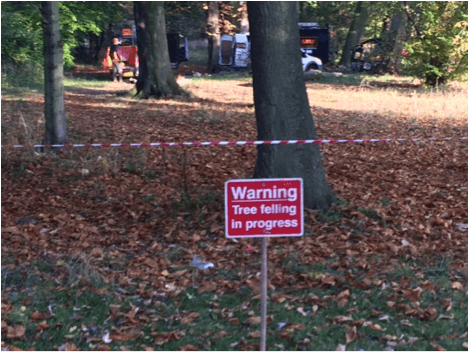
Keep people away from the tree. That includes yourself. A tree that’s down or leaning but still partially attached to the root system or another structure isn’t done moving. Wind direction changes. Wood fibres under tension fail in stages. Don’t go underneath it to get a better look.
Power lines near the tree: stay back, treat the whole area as live, and call your electricity network operator before anyone else. This isn’t something to assess yourself.
If the tree is blocking a road or pavement, the local council or highways authority needs to know. They have a legal responsibility to keep public routes safe and will often step in, or at least manage the area while you sort a contractor.
Photos from a safe distance are genuinely useful when you call. They help the emergency tree removal team figure out what they’re dealing with before they get there, which means the right equipment arrives first time rather than second.
Why This Isn’t a DIY Job
For a small branch that’s clearly stable and nowhere near anything: fine, deal with it yourself. For anything else, don’t.
Size isn’t a reliable guide. A small branch can look easy and still go wrong if it’s under tension or positioned awkwardly. It’s not about being cautious for the sake of it, it’s about not turning a twenty-minute job into an emergency tree removal you didn’t budget for. If there’s any doubt, call first.
Partially fallen trees are loaded with tension that shifts as wood is removed. What looks like a straightforward cut can release that tension in a direction nobody planned for. Emergency tree removal at night, after a storm, often with limited space and difficult access, is exactly the kind of situation where experience and the right kit make the difference between a job done and a situation that got worse.
At Treesaw we stay alert 24/7 and cover most locations since 2011. Hundreds of jobs, day and night. The emergency line is 07754 733124 and it’s answered 24 hours.
What the Team Actually Does When They Arrive
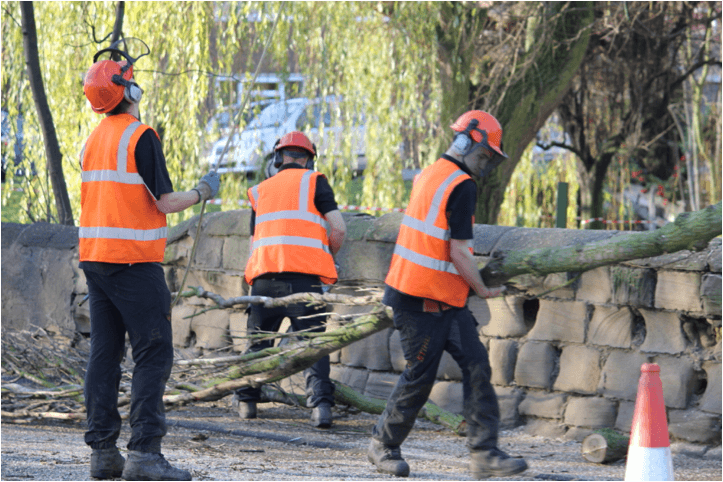
They don’t start cutting. First is an assessment: how the tree is failing, what it’s resting on, whether it’s stable enough to work on straight away or whether something needs to be made safe before the main work starts. Cables nearby. Whether there’s a TPO.
That last one surprises people. A Tree Preservation Order doesn’t go away because a tree came down in a storm. If the tree is protected, the local planning authority still needs to be notified even in an emergency. We handle that as part of the job. You’ve got enough to deal with.
Sometimes emergency tree removal means the tree comes down completely on the day. Sometimes the immediate hazard gets made safe and the rest is finished in a follow-up visit when conditions allow. The goal is making the site safe, not necessarily ticking every box in a single callout.
Insurance
Call your insurer early, ideally before the work starts. Home insurance sometimes covers emergency tree removal if the tree has caused damage to an insured structure. It’s less likely to pay out for a tree that fell in the garden without hitting anything. Knowing where you stand before the bill arrives is better than finding out after.
A written report and photos from the removal team help with any claim. We can provide documentation.
After the Emergency Is Dealt With
The stump and root system don’t disappear when the tree comes down. Stump grinding is usually the logical next step, and our stump removal service handles it as a standalone job if needed.
If other trees on the property went through the same storm, a follow-up check is worth booking. One tree coming down sometimes means others nearby were affected by the same conditions and are now at higher risk.
If it was a neighbour’s tree that came onto your property, or yours that went the other way, document everything early. Liability takes time to resolve and clear evidence from the start makes it considerably less painful.
Getting Help
Treesaw covers Leeds, Bradford, Harrogate, and Wakefield for emergency tree removal, 24 hours a day. We hold AAAC status, ISO registration across Quality, Environmental, and Health and Safety Management, plus CHAS and TrustMark accreditations.
Emergency line: 07754 733124 (24 hours) Office: 0113 239 1271 / [email protected] / contact us here Monday to Saturday, 8am to 6pm.