

How to Tell if Your Tree is Dying: UK Tree Health Guide
Most people don’t notice a tree is struggling until something falls off it. A branch on the lawn after a still night. A canopy that looks thin in June when the one next door is full. Leaves going brown in July. By that point the tree has usually been telling you something for a while. You just weren’t looking for it.
This guide is here to help you look. We’re Treesaw, an Arboricultural Association Approved Contractor working across Leeds, Bradford, Harrogate and Wakefield since 2000. A lot of our call outs start with the same question. Is my tree dying? Sometimes the answer is yes. Quite often it’s no, the tree is stressed and will pick up with the right care. And now and again it’s a tree that looks fine but isn’t safe. Knowing how to tell if a tree is dying really comes down to telling those three apart.
Below is what we check on site, the sick tree symptoms homeowners tend to miss, and what your options are once you know what you’re dealing with.
Why a dying tree is hard to spot
Trees are slow. A tree can take years to die and most of that happens where you can’t see it, in the roots, under the bark or inside the trunk. By the time the canopy shows it the problem has usually been there a good while.
Trees also have bad years that look like dying. A birch dropping yellow leaves after a dry August isn’t the same as a birch with dieback. And every deciduous tree looks dead in winter. So one symptom on its own rarely tells you much. It’s the pattern, and whether it’s getting worse, that counts.
There’s also a delay most people don’t expect. Drought damage often shows a year or two after the dry summer that caused it. So a tree looking rough this year could still be paying for the hot, dry summer of 2025. We see this a lot on Yorkshire clay, which bakes hard in dry weather and makes it tough for roots to get at water. If you want to understand what’s going on inside the tree, our piece on understanding tree biology is a good background read.
Dying or just stressed?
This is the question that matters most, because it decides whether you’re looking at care or removal. The symptoms overlap a lot. The difference is usually how much of the tree is affected and whether it’s spreading year on year.
| What you notice | More likely stress | More likely serious decline |
| Leaves | Wilting or early autumn colour after a dry spell, normal again next year | Small, sparse or discoloured leaves year after year |
| Dead branches | A few small twigs or a shaded lower limb | Dieback across the top of the crown that spreads each year |
| Bark | Small cracks, or natural peeling on birch and plane | Bark falling away, dark weeping patches, soft wood underneath |
| Fungi | Mushrooms in the lawn a few metres away | Brackets on the trunk, or fungus growing from the base or roots |
| Growth | One slow year after a hard summer | Several years of short shoots and a crown that keeps shrinking |
| Stability | Tree stands as it always has | A new lean, lifting soil or cracks in the ground on one side |
Here’s a rough rule our team uses. If less than about a third of the crown is affected and the tree put on healthy growth this year, it’s often worth managing. If most of the crown is dying back, or the problem is in the trunk and roots rather than the leaves, the outlook is poorer. That isn’t a hard rule. It’s a starting point for a proper look.
How to tell if a tree is dying from the top down
Start with the crown because that’s usually where decline shows first. Stand back far enough to see the whole tree and look at it from a few sides. If there’s another tree of the same type nearby, compare the two.
Look for thin patches where you can see a lot of sky through the canopy. Look for bare twigs at the very top while the lower branches still have leaves. On old oaks this is called being stag headed, because the dead top branches look like antlers. And look for clusters of small shoots sprouting straight out of the trunk or main branches.
Those trunk shoots are called epicormic growth. On a lime they’re normal. On an ash or oak that never used to have them, they often mean the crown is failing and the tree is trying to make up for lost leaves. It’s one of the more reliable signs we see.
One simple tip. Take a photo of the tree from the same spot each summer. Comparing two or three years side by side tells you far more than any single look will.
Leaves: colour, size and timing
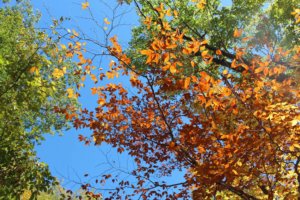
Leaves are where most people first spot a problem. Brown or yellow leaves in midsummer, leaves dropping early, spots and blotches, or leaves that are smaller than they used to be.
Timing is the thing to watch. Early autumn colour after a dry August is often just the tree cutting its losses. But if the leaves are getting smaller every year, or the tree is late and patchy coming into leaf in spring, that points to water not getting up the tree properly. That usually means trouble in the roots or under the bark.
Some leaf problems look awful and aren’t that serious. Horse chestnuts often go brown by late summer from leaf miner and leaf blotch, and most carry on for years. Other leaf symptoms are the first sign of something much worse, like ash dieback. So the species matters a lot. If you’re not sure what you’ve got, have a look at our guide on how to identify the species of a tree.
Deadwood and dieback
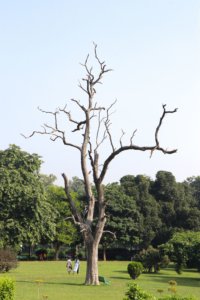
Dead branches are one of the clearest sick tree symptoms. They’re brittle, they snap instead of bend and they don’t come into leaf in spring. Some deadwood is normal in a mature tree, especially lower branches that have been shaded out. Dieback is different. It starts at the tips and works back towards the trunk, and when it’s happening across the whole crown the tree is in real trouble.
Deadwood is a safety issue whether the tree is dying or not. Dead limbs over a drive, path or play area need to come off. Deadwood removal is one of the most common parts of our tree surgery work and sometimes it’s all a tree needs.
Bark, cracks and the trunk
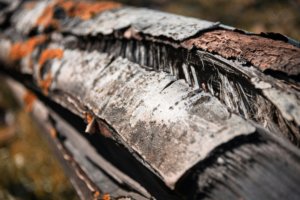 Healthy bark is firm and stays attached. Some trees shed bark naturally, plane, birch and some acers peel as they grow and that’s fine. What’s not fine is bark coming off in sheets to leave bare wood, bark that sounds hollow when you tap it, or patches that feel soft or spongy.
Keep an eye out for dark weeping patches running down the trunk. Look for sunken or split areas, known as cankers. Watch for long vertical cracks, especially fresh looking ones, and for cavities where the wood inside is rotting.
A crack or a hollow doesn’t always mean the tree has to come down. Trees are good at walling off decay and plenty of hollow trees stand for decades. But it does mean the tree needs assessing. How much sound wood is left isn’t something to guess at if the tree is near a house, a road or a neighbour’s garden.
Fungi at the base or on the trunk
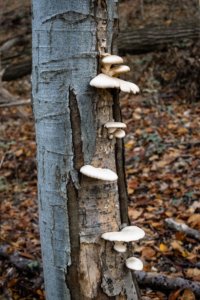
Fungus on a tree is often the visible bit of a much bigger problem. Bracket fungi on the trunk usually mean decay inside. Clumps of mushrooms around the base or coming from the roots can mean root rot.
Honey fungus is the one most people have heard of. The RHS says you can identify it by creamy white sheets of fungus under the bark at the base of the trunk or on the roots. It spreads through the soil and it kills a wide range of trees and shrubs.
Not every mushroom is bad news though. The ones to worry about grow from the tree itself or its roots. Take a photo before you knock them off, as it helps identify what’s going on.
Roots, lean and the ground around the tree
Most tree failures start at the roots and roots are the hardest part to check. Look for a tree that’s started leaning when it didn’t before. Look for soil that’s heaving or cracking on one side of the trunk, roots that are soft or dark, and fungus around the root area.
Also think about what’s changed nearby. New driveways, extensions, trenches for cables or drains, soil banked up against the trunk. Roots spread well beyond the canopy, so work that seems a safe distance away often isn’t. Root damage from building work can take several years to show up in the crown, which is why people rarely make the connection. We’ve covered the flip side of this, where roots damage buildings, in our posts on tree root damage and tree roots and foundations.
The scratch test and its limits
If you want to know whether part of a tree is alive, the RHS suggests a simple check in its guide on why trees and shrubs die. Scrape a small bit of bark off a twig with your thumbnail. Green underneath means living tissue. Brown and dry means that part is dead. If the tips are dead, try again further down on thicker wood to see how far it goes.
It’s handy but it has limits. It tells you whether a bit of the tree is alive, not whether the tree is safe. A large tree can be green under the bark and still have serious decay in the trunk. So treat it as one clue out of many, and don’t scrape big wounds into a mature tree to check.
How to tell if a tree is dying in winter
Winter is when a lot of people panic because every deciduous tree looks dead. But it’s actually a good time to check a tree, because there are no leaves hiding the structure.
Start with the buds. Living twigs have plump, firm buds. Dead ones are shrivelled or fall off when touched. Then bend a thin twig. If it bends, it’s alive. If it snaps clean and it’s dry inside, that bit is dead. Winter is also the easiest time to spot cracks, cavities and bracket fungi on the trunk. And look at the shape of the tree. Dead branches often hang on to old brown leaves long after the rest have dropped.
Evergreens are different. Most conifers won’t regrow from old wood, so brown patches on a leylandii or similar are worth getting checked early rather than waiting to see what spring brings.
Common UK tree diseases and what they look like
Some of the most serious sick tree symptoms come down to specific diseases. We’ve written separate guides on many of them over the years, so here’s a quick run through with links if you want more detail.
Ash. Ash dieback is the big one. It was first found in Britain in 2012, and a 2019 study by the University of Oxford and partners estimated it would kill 95 to 99% of Britain’s ash trees and cost around £15 billion. Signs include dark blotches on leaves, lesions on stems, dead shoots at the top of the crown and lots of small shoots on the trunk. Dying ash gets brittle quickly, which is why we take ash near homes and roads seriously. Read more in our guides to ash tree diseases and European ash tree diseases. You may also read about emerald ash borer. It’s a serious pest abroad but it isn’t established in Britain, and the authorities want to hear about any suspected sighting.
Oak. Acute oak decline causes dark weeping patches on the trunk, vertical cracks between the bark plates and a thinning crown. Small D shaped holes left by a native beetle turn up in roughly a third of cases, and affected trees can go downhill within a few years. See our guide to oak tree diseases.
Horse chestnut. Bleeding canker splits the bark and leaves it oozing a dark, sticky fluid. Leaf miner and leaf blotch turn leaves brown early but are usually less serious. More in horse chestnut tree diseases.
Beech. Watch for scale insects and waxy bark, root rot with large fungal growths at the base, and powdery mildew on young leaves. Fungus at the foot of a big beech needs looking at quickly. See beech tree diseases.
Elm. Dutch elm disease shows as yellow, wilting leaves in summer and twigs bending into a hook. Brown streaks under the bark usually confirm it. See elm tree diseases.
Willow. Black canker, willow scab and anthracnose cause leaf spots, twig lesions and dieback. Willows have brittle wood, so disease on top of that is a bad mix. See willow tree diseases and our guide to pruning willow trees.
Sycamore. Anthracnose, leaf scorch and powdery mildew mostly affect the leaves. More serious is sooty bark disease, where bark peels to show black, sooty spores. Those spores can harm your lungs, so don’t cut or handle an affected tree yourself. See sycamore tree diseases.
Silver birch. Dieback and birch leafminer are the common ones. Birches are fairly short lived trees, so decline in an older birch isn’t unusual. See silver birch tree diseases.
Cherry, plum and blackthorn. Bacterial canker causes gummy ooze and sunken bark. Silver leaf gets in through pruning cuts made at the wrong time of year, and root rot follows waterlogged soil. See cherry blossom tree diseases, blackthorn tree diseases and our plum tree pruning guide.
Rowan. Fire blight leaves flowers and shoots looking blackened and scorched. Crown gall causes lumpy growths low down on the tree. See rowan tree diseases.
Aspen and poplar. Cankers, leaf rust and poplar scab are the ones to watch. See aspen tree diseases.
Signs of a dying tree UK homeowners often miss
Most lists of signs of a dying tree UK homeowners find online stick to the obvious. These are the causes we find on site that people hadn’t picked up on.
Soil or mulch piled against the trunk is a big one. It keeps the bark wet and lets rot in at the base. A lot of raised beds built around trees cause exactly this.
Compaction is another. Parking under a tree, or laying a patio over its roots, squeezes the air out of the soil. Roots need that air. The decline is slow, so it’s rarely linked back to the patio.
Changes in drainage matter too. A new drain, a blocked one or a change in ground levels can leave roots sitting in water. Waterlogged roots die just as surely as dry ones.
Old pruning cuts can come back to bite. Topping and badly placed cuts from years ago let decay in, and the cavity might only show fifteen years later. Our tree pruning UK guide explains how to avoid this.
Then there’s ivy. It’s honestly less of a threat than people think, as it doesn’t feed off the tree. But heavy ivy hides the trunk so you can’t see cracks, fungus or cavities, and it adds weight and wind load to a tree that might already be weak. That’s where our vegetation control work comes in.
A 10 minute tree health check you can do yourself
You don’t need any kit for this. Do it twice a year, once in late spring when the leaves are out and once in late summer, and again after any big storm.
Stand back and look at the whole crown. Is it as full as last year? Then walk around the tree and check the trunk from the ground up for cracks, weeping patches, loose bark, holes and fungus. Look closely at the base and over the roots, check the ground for lifting and see if the tree leans more than before. Finally take your photo from the same spot as last time.
If you find something that worries you, that’s the point to call someone. Knowing how to tell if a tree is dying is useful, but it’s no substitute for a trained eye when the tree is big or close to your home.
When a sick tree becomes a safety risk
A dying tree isn’t always dangerous, and a dangerous tree isn’t always dying. What matters most is what’s underneath it. A declining tree in the corner of a field can often be left standing for wildlife. The same tree over a house, a road or a school path is a very different story. As an owner you’re expected to take reasonable care of the trees on your land.
Some signs mean you shouldn’t wait. A sudden new lean, cracking or creaking sounds, a split trunk, a large broken limb hanging in the canopy, or roots lifting out of the ground. Keep people and pets away and call a professional. Our 24 hour emergency tree work line is 07754 733124. There’s more on what to do in the moment in our post on emergency tree removal.
Can a dying tree be saved?
Sometimes, yes. It depends on what’s causing the problem and how far it’s gone.
Where the tree is stressed or the disease is limited, removing dead and diseased wood can buy it a lot of time. Crown reduction lowers the tree’s water demand and takes weight off weak branches, and our post on crown reduction vs crown thinning explains when each one fits. Sorting out the cause helps too, whether that’s clearing soil from the trunk, fixing drainage or watering young trees through dry spells. And then it’s a case of keeping an eye on it.
When a tree can’t be saved, or it’s too risky to keep, it needs to come down safely. Big trees near buildings are usually taken down in sections rather than felled in one go. Our guide to tree felling and our post on why tree removal can be important go into more detail. Don’t forget the stump either. After honey fungus in particular, the old stump can keep feeding the disease, so stump grinding is often a sensible next step. For larger areas with several failing trees we also carry out site clearance.
One legal point. If the tree has a Tree Preservation Order or sits in a conservation area, you’ll usually need to tell the council before any work, even when the tree is dead or dying. Nesting birds are protected too. We check all of this before any work starts so you don’t have to.
Reporting a tree disease
If you think you’ve spotted a serious or unusual tree disease, you can report it to Forest Research through TreeAlert. It covers England, Scotland and Wales and asks for photos and a location. These reports help track new pests and diseases before they spread.
How Treesaw can help
When we visit, one of our team looks at the whole tree. We identify the species, check the crown, trunk, base and root area, look at what’s around the tree and run the TPO and conservation area checks. Then you get a free written estimate that says exactly what we recommend and why. If a tree doesn’t need work, we’ll tell you. We’d much rather do that than sell you a job you don’t need.
Treesaw has been an independent firm since 2000. We hold Arboricultural Association Approved Contractor status, ISO certification for quality, environmental and health and safety management, plus CHAS and TrustMark accreditation. You can read more about our company and what an ARB approved contractor actually means, or see what customers say on our testimonials page.
We cover Leeds, Bradford, Harrogate and Wakefield. Call 0113 239 1271, email [email protected] or get in touch here. We’re open Monday to Saturday, 8am to 6pm, and the emergency line is 07754 733124.
Frequently asked questions
How long does it take a tree to die? It varies a lot. Some diseases, like acute oak decline, can kill a tree within a few years. Others take decades. Root damage and drought stress often take two to five years to show fully in the crown.
Can a tree look healthy and still be dying? Yes. Decay in the trunk or roots can be well advanced while the canopy still looks full. That’s why fungi at the base, cavities and new leans matter even when the leaves look fine.
Should I cut down a dying tree myself? We wouldn’t recommend it for anything beyond a small shrub. Dead and dying wood behaves unpredictably when cut, and you may need council permission first. See our advice on avoiding a rogue trader when choosing who does the work.
How much does it cost to have a tree checked? Our estimates are free. The cost of any work depends on size, condition and access, and our post on how much tree surgeons charge explains what affects the price.